_edited.png)


Bridging the Gap: How Local Innovation Restores Independence in Fiji


For most people, walking to a neighbor’s house or crossing a small bridge to reach a local store is an ordinary part of daily life, something done without thought or hesitation. For Mrs. Mere Roden, a 58 year old paraplegic living in Fiji, that simple act once felt impossible.
A narrow timber bridge near her home stood between her and the community around her. It was unstable, uneven, and unsafe. Every crossing required careful balance and assistance. What should have been a short trip became a moment of risk and anxiety.

“When I moved here and saw the piece of timber they had, I thought, ‘Oh my goodness, this is totally not right for someone in a wheelchair.’”
Her words reflect more than frustration. They capture the reality faced by many people with disabilities who are forced to navigate environments that were never designed with accessibility in mind. The fragile bridge symbolized exclusion. It limited her independence and quietly reinforced dependence on others for movement that should have been simple.
Across Fiji, this experience is repeated in many forms.
Rough soil, heavy rain, and uneven terrain quickly damage wheelchair tires and assistive devices. Basic components such as crutch tips and casters wear down under local conditions, yet replacement parts are rarely available nearby. Families often wait months for imported supplies, paying high costs and enduring long delays. During that time, mobility stops.
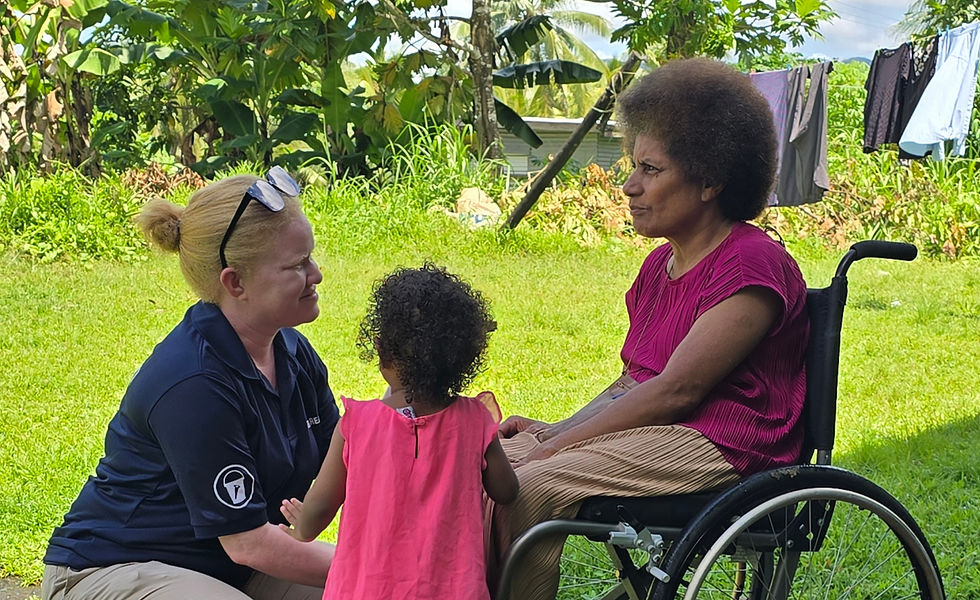
For many households, this is not just an inconvenience. It affects dignity, access to education, participation in community life, and the ability to work or contribute. Small equipment failures can translate into prolonged isolation.
Mere is part of the newly registered Fiji Mobility Association, and her experience has highlighted how urgent localized solutions are. Instead of relying solely on imported equipment, the response in Fiji is shifting toward building capacity within the country.
Through the support of partners and the use of 3D printing technology, essential mobility components such as crutch tips and wheelchair parts are now manufactured locally. This approach allows rapid repairs, reduces dependency on long supply chains, and enables parts to be redesigned and strengthened based on actual terrain conditions.
Local manufacturing means repairs no longer require waiting for shipments. It means technicians can respond quickly when equipment breaks. It means mobility support becomes accessible closer to the communities that need it most.
At the same time, infrastructure improvements addressed the most visible barrier in Mere’s daily life. The unstable timber bridge has been replaced with a strong and durable structure built for safety and long term use. It was designed with accessibility in mind, restoring a safe path for wheelchair users and creating secure passage for everyone in the neighborhood.

When Mere saw the completed bridge, her reaction was powerful. What once represented risk and restriction now represented freedom and possibility. She described it as a dream realized. More than that, she saw how the bridge benefits the entire community. Elderly residents can cross with confidence. Children can walk or run safely across. Neighbors can visit without hesitation.
The impact of this work goes beyond physical structures or fabricated parts. It demonstrates how targeted investment in local innovation strengthens systems rather than delivering temporary fixes. By establishing repair hubs and training local technicians, knowledge and skills remain within Fiji. Communities gain the ability to maintain, adapt, and improve their own mobility solutions over time.
Support from partners such as the Canada Fund for Local Initiatives has made this approach possible. Their investment is not simply funding equipment. It is enabling infrastructure, building technical capacity, and restoring independence to people like Mere.
In places like Fiji, independence is rebuilt through practical action and local ownership.
For Mere, that independence now begins with a safe bridge and reliable mobility support. For the wider community, it signals a future where access is not limited by geography or supply chains but strengthened by innovation rooted in place.